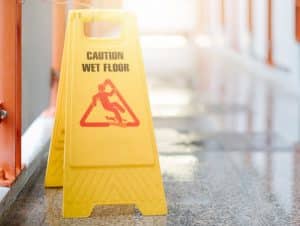


In Florida, a fall alone does not create a case. If you slip on water, food, soap, or tracked-in rain inside a business, you usually need proof that the business knew about the hazard or should have known about it.
Under Florida Statutes section 768.0755 slip and fall proof comes in two forms: actual notice, which means someone at the business knew about the danger, and constructive notice, which means the hazard was there long enough to be found or kept happening often enough in that spot to be predictable.
That notice rule is the part most people miss. The real question is not just, Was the floor wet? The real question is, What shows the business had fair warning and failed to act?
The essential tenet to understand is that a business is not liable just because you fell. You need proof that ties the hazard to what the business knew, what it should have caught, or what kept happening in that same area.
Actual Notice Means Someone at the Business Knew
Actual notice is the short route. You are showing that the business created the hazard, saw it, or got told about it before you fell. Florida courts describe actual knowledge as knowledge the business or one of its agents had of the dangerous condition, including cases where the business created it. That can look very ordinary in real life. An employee mops a restroom and leaves the floor wet.
- A manager gets a complaint about a leaking freezer and does nothing.
- A worker spills liquid while stocking shelves and walks off to do something else.
Those are actual-notice facts if the proof connects the business to the exact condition that caused the fall.
A good example is Ruth v. Guerrieri Management, Inc., a 2024 Fifth District case. The incident report said the restroom floor had just been mopped, and the customer slipped on that wet floor. The court said that record was enough to let a jury decide the case.
Actual notice matters, but it is not where most of the real fights happen. Most businesses do not admit, “Yes, we knew that puddle was there.” That is why constructive notice usually takes center stage.
Constructive Notice Is How You Show the Business Should Have Known
Constructive notice means you do not have direct proof that someone at the business saw the hazard. You are proving the business still should have known about it. Under section 768.0755, that can happen in two ways:
- the hazard was there long enough that staff should have found it, or
- the same kind of hazard kept happening in that spot often enough to make it foreseeable.
Lawyers and courts often talk about a “plus” factor here. Your statement that you slipped on something is not enough by itself. You need something more, some extra fact that lets a jury say the substance was not brand new.
Footprints, Track Marks, and Traffic Patterns Can Show Age
One of the clearest plus factors is proof that others have navigated the hazard before you did. Footprints, shoe marks, and shopping cart tracks can help show the substance had been there long enough for staff to find it.
In Welch v. CHLN, Inc., the plaintiff described a dirty, murky, slimy puddle with footprints going in different directions. In Leftwich v. Wal-Mart Stores East, LP, the customer described track marks and footprints through a squished grape. In both cases, the court said the evidence was sufficient to allow the claim to move forward.
A clean puddle looks different from one that people have already walked through. That difference can help turn a guess into proof.
Dirty Liquid, Dried Edges, And Changed Texture Matter
Courts also look at the condition of the substance itself. Dirty liquid, grime, dried edges, scuff marks, or a changed texture can suggest the hazard had been sitting there for a while.
In Loren v. Once Upon a Time Group, Corp., the plaintiff described greasy, dirty water that left a black stain on white pants. Both cases treated those details as meaningful notice evidence.
That is why photos right after a fall matter. They can show whether the spill looked fresh or old.
Winning Cases Have More Than “There Was A Spill”
The difference between a strong case and a weak one is often simple. Strong cases have the fall plus at least one real marker of age, traffic, or repeated risk. Weak cases stop at, “There was something on the floor.”
A Florida slip and fall case gets stronger when the evidence shows the hazard had time, history, or a pattern. It gets weaker when the proof goes no further than a wet floor.
Repeating Hazards Can Prove Notice Too
You do not always need to prove how many minutes a specific spill sat on the floor. Florida law gives you a second path. If the same dangerous condition kept happening in that spot, and that pattern made the risk foreseeable, that can establish constructive notice too.
South Florida properties often face the same slip hazards again and again. Self-serve drink stations drip onto the same tile, hotel and grocery entrances collect tracked-in rain, freezer cases and A/C systems leave the same areas slick, and outdoor walkways near pools or landscaping can stay damp or grow algae. Those are recurring conditions, not one-time surprises.
Loren is a strong example. The Fourth District pointed to dirty, greasy water, humid conditions, recurring condensation, and testimony that a mat was usually kept near the area for safety, yet was missing when the plaintiff fell. That let the jury treat the condition as foreseeable, not random.
The flip side is Publix Super Markets, Inc. v. Safonte. There, a customer dropped yogurt, and the spill sat on the floor for only about two minutes before the fall. The court held that this was too short a window for constructive notice, and it also rejected the idea that the spill was part of a recurring condition attributable to Publix.
HB 837 Raised the Stakes for Weak Notice Proof
Florida’s 2023 tort reform bill, HB 837, changed negligence cases in ways that hit slip and fall claims hard. The changes that matter most here are the 51 percent fault bar, the shorter filing deadline, and the new rules for medical expense proof.
First, Florida now bars recovery in most negligence cases if the injured person is found more than 50 percent at fault for his or her own harm. That means the defense has every reason to argue you should have seen the puddle, watched where you were going, or avoided the area. Strong notice evidence helps push the case back where it belongs: on what the business failed to do with a hazard it knew about or should have caught.
Second, negligence actions now generally sit under a two-year filing period in section 95.11. That deadline matters, but the practical deadline is often much sooner. Video gets overwritten. Floors get cleaned. Employees move on. Witnesses forget what they saw.
Third, section 768.0427 changed how medical expenses are proven at trial and added disclosure rules tied to letters of protection. That issue sits on the damages side of the case, not the notice side, though it adds more pressure to build a clean record from day one.
The Evidence That Wins and Loses Slip and Fall Cases
The best evidence in a notice case is proof of age, pattern, or awareness. A photo that shows you on the ground is far less useful than a photo that shows the condition of the substance, the surrounding floor, nearby mats, warning signs, and foot traffic.
Photos Should Show the Condition of the Hazard
Take pictures that show color, spread, footprints, dried edges, grime, streaks, cart marks, doors, vents, drains, and lighting. Those details are what courts use to decide if the hazard looked fresh, old, or recurring.
Video Can Prove Time and Employee Awareness
Surveillance footage is often the best notice evidence in the building. The key footage is usually the time before the fall, not the fall itself. You want to know when the spill appeared, how long it stayed there, and whether employees walked past it without fixing it. Businesses overwrite video fast, so a written preservation request should go out right away.
Witnesses and Incident Reports Can Change the Whole Case
A witness who saw the spill ten or twenty minutes earlier can be powerful. So can an employee who says the same doorway, cooler, drink station, or restroom gets slick all the time. Incident reports matter for the same reason. They can create a same-day record of what the business said happened before anyone had time to rewrite the story. The Ruth case is a perfect example: the incident report was a major piece of the proof.
Shoes and Clothing Can Preserve What the Floor Looked Like
Do not throw out the shoes or clothes you wore in the fall. Wetness, residue, grease, dirt, or staining can help back up your account of what was on the floor. In Loren, the plaintiff’s white pants had a black stain after the fall, and that detail became part of the notice analysis.
Here is a stronger, cleaner closing with a more natural bridge to the practice area page:
Talk to a Lawyer Before the Evidence Is Gone
Florida slip and fall cases often turn on one issue: notice. You can have a serious injury and still have a weak case if the evidence does not show the business knew about the hazard or should have found it under section 768.0755.
Speed matters in these cases. Spills get cleaned up, footprints fade, video gets erased, and witnesses move on. Stabinski Law has handled slip-and-fall cases in South Florida for decades, and the firm knows how to move quickly to secure evidence that can make or break a case. If you were hurt in a fall, Stabinski Law can evaluate what happened, explain where your case stands, and take fast steps to preserve the proof.
Frequently Asked Questions About Notice in Florida Slip and Fall Cases
How long does a spill need to be on the floor?
There is no fixed time. Florida courts look for signs the hazard had been there long enough to be found, such as footprints, track marks, dirty liquid, dried edges, or other evidence that people had already passed through it.
Does the business have to actually know about the hazard?
No. You can still have a case if you prove the business should have known, because the hazard was present long enough to be discovered or to keep happening in the same area.
Can I still recover if I did not see the hazard before I fell?
Yes. Not seeing the hazard does not automatically defeat the case, but the defense may argue you were partly at fault, which makes strong notice evidence even more important.
How long do I have to file a Florida slip and fall lawsuit?
In most cases, two years. Waiting is risky because videos can be erased, the scene can change, and witnesses can forget details.