

Does a Slip and Fall Due to Rain Mean the Property Owner Is Liable?
During the rainy season, Miami sees showers almost every day, and businesses must be prepared. Water gets tracked inside through building entrances, storefronts, hotel lobbies, and restaurants, creating slippery conditions in a moment’s notice.
Establishments have a responsibility to maintain safe walkways on their property, but does that mean they are automatically liable for slips and falls due to rain?
Not quite. Under Florida Statute § 768.0755, the injured party must prove the business had real or constructive knowledge of rainwater on its property and enough notice to take action to remedy it.
So if the mere presence of a wet floor doesn’t prove legal liability, the real question then becomes: “Did the business know? Should they have known?”
For the wider picture on proving what a business knew, see Florida Slip and Fall Notice: How to Prove the Business Knew.
Rainwater Can Create a Hazard Without Automatically Creating Liability
A wet floor can appear very quickly during active rainfall, giving businesses little time to act. In order to be held liable for slips and falls on their property, the time between the floor getting wet and someone slipping on it has to be long enough for the business to discover it under reasonable circumstances.
In Walker v. Winn-Dixie Stores, Inc., a customer had slipped on water almost immediately after it started raining. Employees had inspected the area a few minutes before the accident, showing that Winn-Dixie had done its due diligence and could not have reasonably known about the existence of the wet floor.
So, clearly, timing matters.
Learn more about grocery store slip-and-fall cases on our blog: Grocery Store Slip and Falls: Spills, Produce Misting, and Self-Service Areas
What Florida Law Requires in a Rain-Related Slip-and-Fall Claim
Florida Statutes § 768.0755 explains that when someone slips on a transitory foreign substance (i.e., a temporary substance in a place it doesn’t belong, such as rainwater) the injured person must prove that the business had actual or constructive knowledge of the dangerous condition and should have taken action to remedy it. The rule applies to falls in a business establishment. A fall at an apartment or home can follow different rules.
What Is Actual Knowledge?
Actual knowledge means the business knew about the specific conditions that led to the fall. A puddle that was witnessed and left by an employee, the placement of a wet floor sign near equipment that had just been out in the rain, or a manager who receives a customer complaint can all indicate that a business literally knew about the particular hazard that resulted in an injury.
What Is Constructive Knowledge?
Constructive knowledge means that the business should have known about the hazardous conditions, even if they actually didn’t. In Florida slip and fall cases, it’s expected that a business would have reasonable knowledge about the appearance of a transitory substance if:
- The dangerous condition was there long enough that the business should have discovered it.
- The condition happened often enough that the business should have expected it.
Both scenarios imply that if the business had taken ordinary care to keep the property safe, the hazard could have been found and addressed before anyone got hurt.
When Rain May Create an Unreasonably Dangerous Condition
There is an important distinction between recurring weather patterns and other recurring conditions a business could foresee. In Ausburn v. Wesley Chapel-T, LLC, a 2026 decision, a Florida appeals court held that evidence a service bay often got wet on rainy days wasn’t enough on its own. Section 768.0755 requires a dangerous condition that occurs with regularity, such as a floor that gets slippery and not just wet. The injured man also couldn’t say what he had slipped on.
Missing, Saturated, or Poorly Placed Entrance Mats
Entrance mats are a common way to control water tracked in from rain showers, and businesses should be inspecting mats regularly for safety. If entrance mats are missing, soaked through, curled over, or inadequately sized, that may serve as evidence of negligence.
Water That Accumulates Faster Than Employees Remove It
Businesses are expected to routinely inspect walkways and clean up wet areas when they discover them. Knowing how often the business carries out these inspections and cleanups can help determine whether they should have been aware of accumulating water and just weren’t acting fast enough.
Poor Drainage and Recurring Puddles
If rain uncovers an underlying issue with drainage or leaks on the property, it opens up the question of foreseeability. Rain alone doesn’t make every wet floor foreseeable. But if a leak or a puddle shows up in the same spot every time it rains, that evidence may show a condition that ‘occurred with regularity and was therefore foreseeable’ under Section 768.0755.
Missing or Ineffective Warning Signs
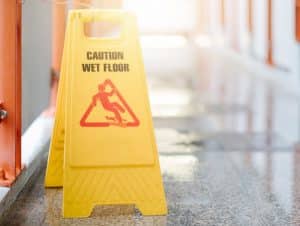
Wet-floor warning signs indicate that a business knew about the hazard and took action, but that doesn’t automatically remove liability. The placement of signs requires context. If a wet-floor sign was hidden, placed too far from the water, or set out only after someone fell, that may be evidence the business didn’t take reasonable action.
How Miami Businesses Can Anticipate Sudden Storms and Heavy Foot Traffic
There are a handful of practical steps that businesses can take to protect employees and customers from slippery conditions during a storm. Florida’s slip-and-fall statute doesn’t list required safety measures. Regular inspections, cleanup routines, entrance mats, and warning signs are common ways businesses prepare for rain, and whether a business used them may matter in a claim.
Why a Recurring Rain Problem Matters
As explained in Ausburn v. Wesley Chapel-T, LLC, recurring rain doesn’t make every puddle foreseeable. Wet conditions can lead to slips and falls on short notice, and businesses can’t always act in the mere moments between the appearance of a hazard and an accident. That’s why proving liability is much more than pointing at the weather forecast and calling it case closed. Convincing evidence must be gathered to show that either the business knew about the water or that it should have known about it due to a repeated issue outside of the weather itself.
Freshly Mopped Floors and Floor Traction Standards
A floor an employee just mopped during a storm is a wet condition the business itself created, which may bear on what the business knew. The National Floor Safety Institute publishes voluntary industry standards on floor traction, including NFSI B101.5, a labeling guide for the wet traction of floor products and footwear, and B101.6, a guide to commercial entrance matting. These standards aren’t Florida law, but they may help show what reasonable care looked like.
What Evidence Can Show a Business Knew or Should Have Known About the Water?
Circumstantial evidence about the timing, appearance, and recurrence of wet conditions can be used to demonstrate whether a slip and fall was the result of negligence.
Photos of the Exact Area: Images can show the scene of the injury at the moment the fall occurred before a business can change anything. They can capture the floor mats and entranceways, whether warning signs were visible, and other conditions that could have contributed to the accident.
Surveillance Footage: Video can show when the water appeared, how long it lasted, and whether the business inspected the area and took any action to warn patrons or clean up.
Incident Reports, Witnesses, and Employee Statements: Testimony from employees can show what the business thought or knew at the time of the injury. Other witness statements can establish whether anyone else was aware of the hazard and if this same problem had been seen before.
Inspection, Cleaning, and Maintenance Records: Business records can provide documented evidence of whether the business had time to discover the water and whether the issue was a regular occurrence.
Weather Records: Weather itself isn’t proof, but it can establish when the rain happened and how long it lasted in the context of the accident.
How Long Does Rainwater Have to Be on the Floor Before a Business Can Be Liable?
There isn’t an established amount of time businesses have before they are liable for a slip and fall due to rain. The question is whether the water was there long enough that, with ordinary care, the business should have known about it.
That can make things difficult when a slip and fall happens immediately after water appears or when it’s unclear when the hazard occurred. Circumstantial evidence has to be introduced in these cases to help establish what was happening in the moment and if a breach of duty occurred that led to the accident.
When a Rain-Related Fall May Point to Poor Maintenance or Planning
When we investigate a rain-related slip-and-fall case, we’re looking for a clear picture of the facts. Did the business have enough time to act after the rain started? Was there any indication that a recurring issue contributed to the incident?
When we investigate rain-related slip and fall cases, we investigate for evidence of poor maintenance or planning: recurring puddles, prior complaints, repeated leaks, displaced or saturated mats, drainage problems, prior similar incidents, and evidence employees already knew about the condition. These details are contrasted with circumstantial evidence about how long dangerous conditions were present and if reasonable actions had been taken.
At the end of the day, evidence preservation can make or break a rain-related slip and fall claim. When liability isn’t guaranteed, it takes fast action and careful documentation to prove that poor maintenance and planning were at play.
Frequently Asked Questions About Slip and Falls Due to Rain in Florida
Is a Store Liable If I Slip on Rainwater in Florida?
Sometimes. A claimant generally must prove the business had actual or constructive knowledge of the dangerous condition and should have acted to remedy it.
Does a Wet-Floor Sign Prevent Me From Bringing a Claim?
A warning sign is relevant evidence, but it does not by itself resolve every slip-and-fall claim. The timing and location of the sign can indicate whether reasonable action was taken to prevent injury.
How Long Does Water Have to Be on the Floor?
Florida law gives no fixed number of minutes. The question is whether the condition existed long enough that ordinary care should have led to its discovery.
Can Repeated Rainwater Problems Establish Constructive Knowledge?
Possibly, if evidence shows the dangerous condition itself occurred regularly and was therefore foreseeable. Predictable weather conditions alone don’t prove liability.
Talk to Stabinski Law About a Slip and Fall Due to Rain
If you slipped on a wet entrance or a just-mopped floor in Miami or anywhere in Florida, tell us what happened. We can review what the business knew, how long the water may have been there, and whether there is a basis for a claim.
Learn about our Miami slip and fall lawyers or call 305-643-3100.